Invisible to ChatGPT? Three measures for more visibility
You invest in your website, maybe even in search engine optimization. Nevertheless, there are fewer inquiries than before. This is no coincidence.
Because the way people search for service providers and products is changing. And many medium-sized companies and craft businesses are not noticing it enough.
The problem: Search is disintegrating into Google, portals and AI answers
A recent study by the German Association for Industrial Communication (bvik) shows that 86 percent of the marketing managers surveyed consider optimization for AI search engines necessary. The reason: More and more research is being done via digital assistants such as ChatGPT, Perplexity or Google Gemini, in addition to classic search engines.
The market research company Gartner predicts that the classic search volume on Google could fall by 25 percent by 2026 because chatbots and virtual agents are taking over market share. Mind you: a forecast, not a fact. But the trend is clear.
An example from the skilled trades:
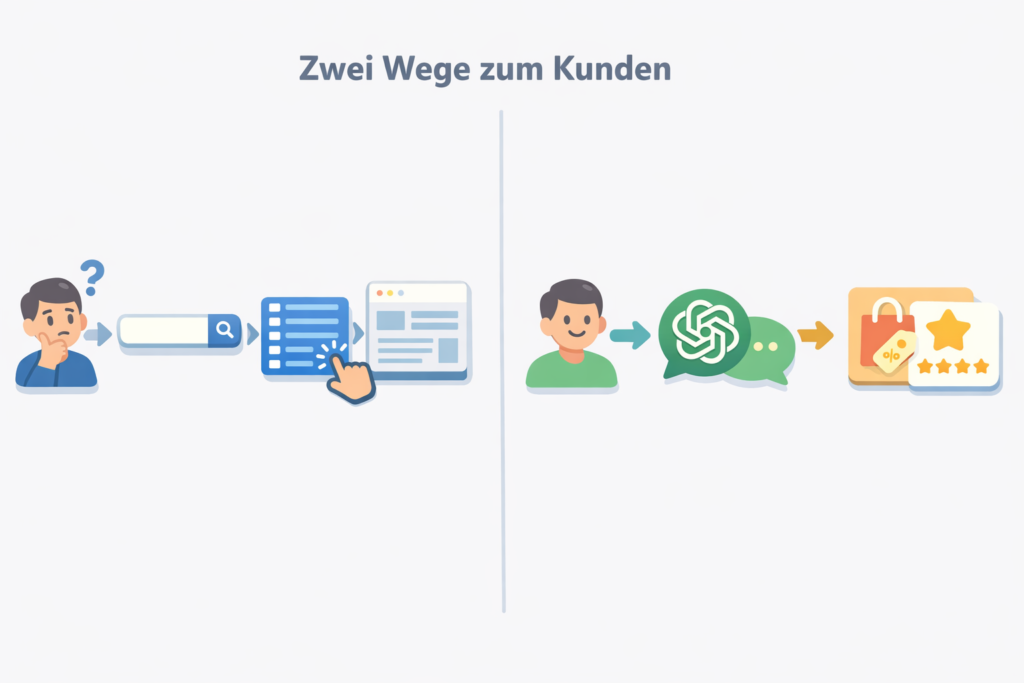
Previously, a homeowner searched on Google for “heating engineer Frechen reviews” and clicked through ten results.
Today, he also asks ChatGPT: “Which heating engineer near me has experience with heat pumps in old buildings and can make an appointment at short notice?”
The difference: ChatGPT provides a direct answer with recommendations, naming only those companies that the AI system considers relevant and trustworthy. Google remains important, but an additional channel is emerging in which many companies are not yet visible at all.
From SEO to GEO: What this means for your business
This development has a name: Generative Engine Optimization, or GEO for short. Unlike classic SEO, which aims at rankings in search results, GEO is about being named as a trustworthy source by AI systems.
Important: SEO remains the foundation. GEO comes on top.
The differences:
| Classic SEO | New GEO |
|---|---|
| Goal: High ranking on Google | Goal: Be mentioned in AI answers |
| Success = Clicks on your website | Success = Your company is mentioned |
| Focus: Search terms and links | Focus: Expertise and clear information |
| Customer clicks, compares, decides | AI pre-filters, customer gets recommendation |
The crucial point: With GEO, there is no reliable ranking like page 1. Visibility is volatile. Often, a few sources win disproportionately, while others do not appear at all. This depends on the prompt, the region and the respective AI system.
The beauty of it: What works for GEO almost always improves your classic Google visibility as well. So you are not investing in an either-or, but in a both-and.
Three concrete measures that you can implement immediately
The good news: You don’t have to be a technology expert. And the measures that work for GEO simultaneously strengthen your classic SEO.
Technical note in advance: AI systems can only quote what they can crawl, understand and index. Therefore, technical SEO basics and structured data remain relevant. A slow or poorly structured website will hurt you in both worlds.
1. Answer your customers’ questions directly
AI systems prefer content that provides clear answers. Instead of long introductions, you should put the most important information at the beginning. This helps both Google and ChatGPT.
Not like this: “In today’s world, it is more important than ever to deal with the topic of heating renovation. Many factors play a role when it comes to finding the right partner…”
Better this way: “A heat pump in an old building costs between 15,000 and 35,000 euros including installation. The subsidy covers up to 70 percent. The most important cost factors are: Heat pump type, development of the heat source and necessary adjustments to the heating distribution.”
Tip for craft businesses: Create an FAQ page on your website with the most frequently asked customer questions. Answer them specifically with figures and facts. This improves your chances with Google and with AI systems alike.
2. Strengthen your local visibility and mentions
For SEO, backlinks count. With AI systems, mentions, reviews and directory entries are becoming increasingly important because they serve as quotable sources. Both can be combined.
The local basis for trade and medium-sized businesses:
- Consistent company data everywhere (name, address, telephone identical)
- Actively collect customer reviews (Google, Proven Expert, industry portals)
- Be present in regional craftsman portals
- Be listed with the regional Chamber of Industry and Commerce
- Show reference projects with location details on your website
Tip: Ask satisfied customers specifically for a review, preferably immediately after project completion, when satisfaction is still fresh. Google rewards this, and AI systems also pick up on these signals.
3. Show your expertise
Both Google and AI systems evaluate who has genuine expertise. Only those who are perceived as experts rank well and are cited by AI. This is your chance, because this is exactly where medium-sized businesses have an advantage over large corporations.
That means specifically:
- Introduce your team with qualifications (master craftsman’s certificate, certifications, further training)
- Show completed projects with a description of the challenge and solution
- Publish specialist articles on your specialist area
- Keep your website up to date (make update date visible)
- Name concrete figures: years of experience, number of projects, catchment area
Example: An electrical company with 25 years of experience in PV installation has more practical knowledge than any marketing department of an energy group. Making this knowledge visible is the key for SEO and GEO.
The opportunity for trade and medium-sized businesses
Here lies a real opportunity: While large companies often work with interchangeable texts, craft businesses and medium-sized companies have genuine expertise in their specialist areas.
An HVAC company that has been installing heating systems for 30 years knows more about the pitfalls of old building renovation than any corporation. A master painter knows the regional conditions and can assess which facade paint will hold on which substrate.
Systematically processing this knowledge and making it available online is what makes you visible. On Google and on AI systems.
Practical help: The GEO text optimizer in the auraHub
You want to optimize your existing website texts for AI search engines, but don’t know where to start? That’s exactly why we have developed a micro-app in the auraHub: the GEO text optimizer.
Here’s how it works:
You enter your existing text, for example from your service page or your about us page. The app analyzes the text and provides you with:
- A GEO-optimized version with concrete improvements
- FAQ suggestions that you can adopt directly
- Notes on where figures, facts and qualifications are missing
- Structure suggestions for better readability by AI systems

An example:
Before: “We are a family business from Frechen and have been building high-quality pools for many years. Our experienced staff will be happy to advise you.”
After: “Poolbau Müller from Frechen: Family business with 25 years of experience and over 200 realized projects in the Rhein-Erft district. We plan and build private swimming pools from 15,000 to 80,000 euros, from consulting to completion from a single source.”
Additional recommendations from the app:
- Add FAQ: “How much does a pool in the garden cost?” / “How long does the pool construction take?”
- Show expertise: Name master craftsman’s certificate, certifications, association memberships
- Specify catchment area: List cities and districts
The advantage: You don’t have to write any prompts. The app guides you through the process, even without prior AI knowledge.
Start now, don’t wait
GEO is not pie in the sky, but also no reason to panic. The shift towards AI-supported search is not happening overnight, but continuously. The companies that start adapting their online presence today will have a head start.
That doesn’t mean turning everything upside down. SEO remains the basis. The basic principles remain: quality, expertise, clear information. GEO merely expands the target group: from customers who search Google themselves to AI systems that pre-filter for customers.
The first step: Test it yourself. Open ChatGPT or Perplexity and ask a typical customer question about your industry and region. For example: “Which roofer in Cologne can you recommend for a flat roof renovation?” The result will show you where you stand.
Frequently asked questions about GEO and SEO
What is the difference between SEO and GEO?
SEO (Search Engine Optimization) optimizes your website for classic search engines like Google to appear as high as possible in the search results. GEO (Generative Engine Optimization) additionally optimizes your content for AI systems such as ChatGPT, Perplexity or Google Gemini so that they recommend your company in their answers. SEO remains the basis, GEO extends it by a new channel.
Do I have to choose between SEO and GEO?
No. The measures overlap strongly. Well-structured content, clear answers to customer questions and visible expertise improve both your Google ranking and your chances of being cited by AI systems. You invest in both at the same time.
How do I find out if my company is visible on ChatGPT?
Test it yourself: Open ChatGPT or Perplexity and ask a typical customer question about your industry and region. For example: “Which heating engineer in Cologne can you recommend for a heat pump in an old building?” If your company is not mentioned, there is a need for action.
What does GEO optimization cost?
The basics cost nothing but time: create FAQ pages, show references with location details, collect reviews, make qualifications visible. For a professional analysis and strategy, you can arrange a free initial consultation with us.
How long does it take for GEO measures to take effect?
AI systems update their knowledge base at different speeds. Changes to your website can take weeks to months to take effect. More important than quick results is continuity: Regularly maintained content and growing reviews strengthen your position in the long term, on Google and on AI systems.
Is GEO only relevant for large companies?
On the contrary. Craft businesses and medium-sized companies have a natural advantage: genuine expertise. A master craftsman’s business with 30 years of experience has more relevant knowledge than any corporate marketing department. Making this knowledge visible online is the key.
How does the GEO text optimizer from auraNexus.ai work?
The GEO text optimizer is a micro-app in the auraHub. You enter your existing website text and receive an optimized version with concrete suggestions for improvement, FAQ ideas and notes on missing facts and qualifications. You don’t need any AI knowledge, the app guides you through the process step by step.
Would you like to know how visible your company is to AI search engines?
In a free initial consultation, we will jointly analyze your current situation and show you concrete options for action.
Post Tags :
Share :
Website ChatGPT Visibility, GEO Generative Engine Optimization, Trade AI Search Engines, Medium-Sized Businesses ChatGPT, Website AI Optimization, Perplexity Google Gemini, Local AI Visibility, Craft Business Online Visibility, AI Search Results, Online Expertise, Website Update, Customer Reviews AI, GEO SEO Difference
More articles on this topic
Individual instructions for AI. How to optimally use ChatGPT and Claude to achieve better results.
AI platform for companies. AI platform with micro apps and enterprise search for structured AI use. AI platform with micro apps and enterprise search for structured AI use.
AI in the skilled crafts. Practical examples of AI use in skilled crafts businesses and how to get started. Practical examples of AI use in skilled crafts businesses and how to get started.
AI Governance thought pragmatically. How to introduce AI guidelines without stifling innovation.