Custom GPTs in the Enterprise:
5 limitations I see in practice
Custom GPTs are the new darling in many companies. Created in ten minutes, given their own name and shared within the team. The temptation is great to consider the AI strategy as complete. But anyone who looks closer will recognize: There are worlds between a Custom GPT for the personal to-do list and an enterprise-wide AI solution. This article shows where the boundaries lie. And why micro apps like auraHub from auraNexus.ai are a real alternative.
What Custom GPTs are good at
Fairness first: Custom GPTs have their justification. With this feature, OpenAI has created something that considerably simplifies the entry into AI use.
Quick start: In just a few minutes, you can create a GPT that is tailored to a specific use case. No code, no IT department, no project application.
Easy customization: Name, description, instructions and optionally upload your own files. The interface is intuitive, the learning curve is flat.
Good for prototypes: If you want to test an idea quickly, you will find a useful tool in Custom GPTs. Does the use case work in principle? A Custom GPT provides an answer in hours for which weeks would otherwise be necessary.
Personal productivity: For the individual knowledge worker who wants to optimize their emails or speed up research, Custom GPTs are a real help.
So much for the sunny side. But when it comes to company-wide use, the downsides become apparent.
The five limitations of Custom GPTs in enterprise use
1. No on-premises operation possible
Custom GPTs run exclusively on OpenAI’s cloud infrastructure. Even ChatGPT Enterprise does not offer an on-premises option. Every request, every uploaded document, every answer goes through servers in the USA.
Regulated industries such as pharmaceuticals, financial services or the public sector often have strict requirements as to where data may be processed. Although the GDPR allows data transfers to third countries under certain conditions, the legal gray area remains. Many compliance departments wave goodbye as soon as they hear US Cloud.
Anyone who needs to keep data in their own data center simply cannot use Custom GPTs. This applies regardless of the selected OpenAI tariff.
2. Vendor lock-in with OpenAI
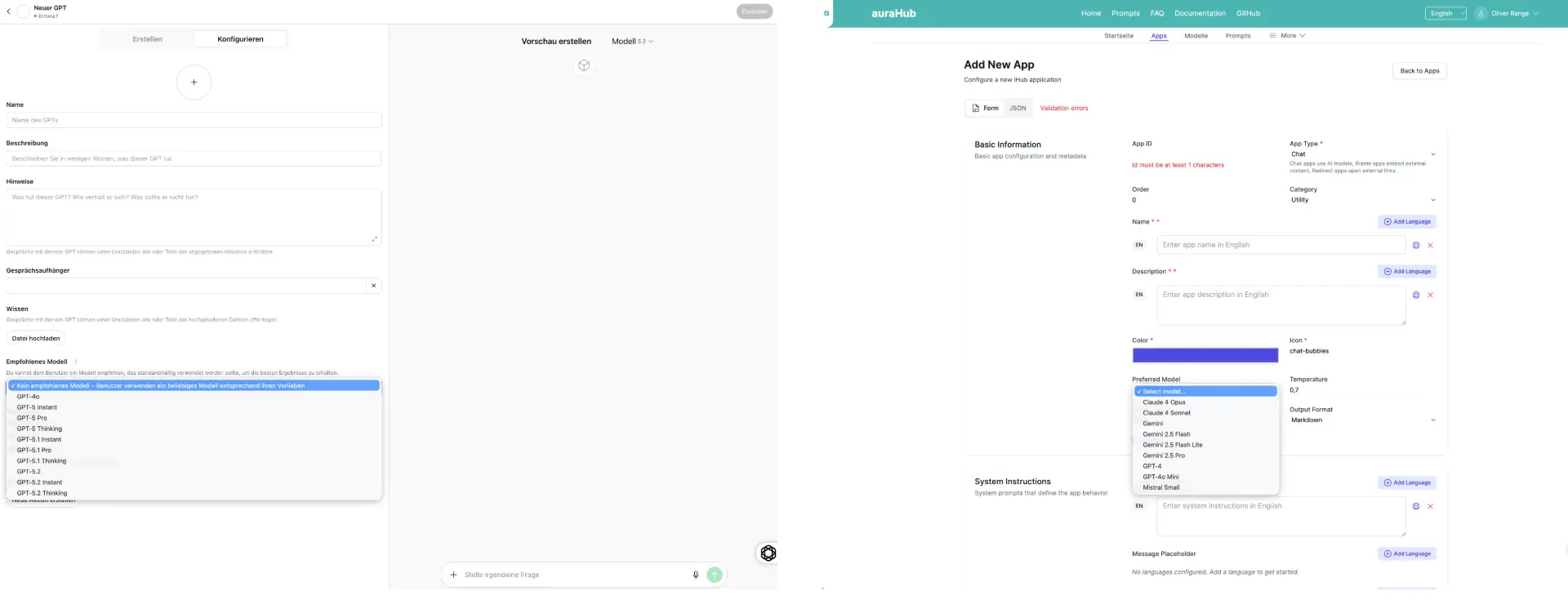
A Custom GPT runs exclusively on OpenAI models. Since August 2025, GPT 5 has been standard, currently GPT 5.2. The choice of language model is not a choice, it is predetermined.
The AI landscape is developing rapidly. Claude from Anthropic is impressive for analytical tasks. Mistral offers European alternatives. Google Gemini is catching up. Local open source models like Llama are becoming increasingly relevant for sensitive applications.
Anyone who relies entirely on Custom GPTs today is tied to a single provider. Price increases, function changes, availability problems: All of this is beyond your control. Migrating to another model means starting all over again.
3. The prompt problem remains
Custom GPTs have an instruction in the background, but the user interface remains a chat window. The employee types their request into an empty text field. That’s exactly the problem: Most people don’t know how to effectively address an AI.
A Custom GPT named Press Release Assistant is better than a blank ChatGPT. But the user still has to formulate what they want. Write me a press release about our new product delivers different results than a structured prompt with headline, lead, quote and boilerplate.
The quality still depends on the user’s prompt engineering skills. That’s not progress, that’s the old problem in a new guise.
4. No real rights management
In ChatGPT Enterprise, Custom GPTs can be activated for specific user groups. That’s a start. But what happens to the data that the GPT processes?
An example: The HR GPT is supposed to help with the creation of job advertisements and gets access to salary bands. Who guarantees that only HR employees use this GPT? And what happens if someone asks: Show me all salaries in department X? The GPT has no idea whether the person asking is allowed to see this.
Real enterprise applications need granular rights management: Who is allowed to see which data? Who is allowed to perform which actions? These concepts do not exist in Custom GPTs.
5. Limited access to company knowledge
Custom GPTs allow uploading files. That sounds like a solution for accessing internal knowledge. In practice, it is not.
Technical limits: 512 MB max. per file | 20 files max. per GPT | 2 million tokens max. per text document
A SharePoint with thousands of documents? Doesn’t fit. A Confluence instance with years of knowledge articles? Impossible. And even with individual files: There is no semantic search, no vector indexing, no relevance assessment. The GPT searches the files as best it can. But that is far from a professional enterprise search with RAG connection.
The real strength of AI in the company unfolds when it can access the entire company knowledge: rights-checked, up-to-date, semantically understood. Custom GPTs cannot do that.
Comparison: Custom GPTs vs. auraHub Micro Apps
The following table summarizes the main differences between Custom GPTs and the AI platform auraHub from auraNexus.ai:
Criterion | Custom GPTs | auraHub (auraNexus.ai) |
Deployment | Only OpenAI Cloud (US) | On Premises or Cloud |
Model selection | Only GPT 5 / GPT 5.2 (OpenAI) | OpenAi, Claude, Gemini, Mistral |
User input | Free text field (prompt) | Structured input mask |
File Upload | Max. 20 files, 512 MB/file | Enterprise Search + RAG |
Rights management | Only GPT sharing | Role-based, document-accurate |
GDPR Compliance | Limited (US Server) | Full (for On Premises) |
Cost/User/Month | Business: 25 to 30 USD, Enterprise: approx. 60 USD | Project-based |
Suitable for | Prototypes, personal use | Productive Enterprise Use |
What companies really need
The limitations of Custom GPTs show what is important in the enterprise context. At auraNexus.ai, we therefore rely on a different approach: auraHub, an AI platform with micro apps.
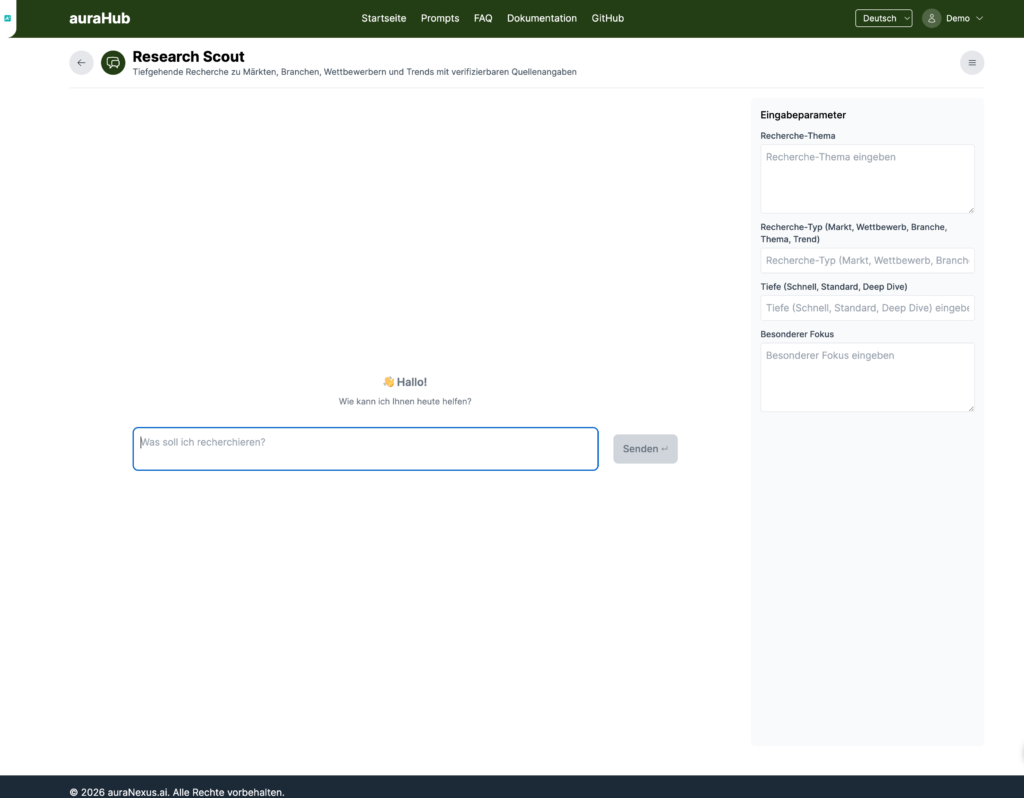
Structured inputs instead of free prompts: In auraHub, users select from predefined fields: topic, tonality, length, target group. No prompt engineering required. The AI works in the background, the human remains the focus.
Model flexibility: Each auraHub Micro App can use a different model. Claude for analyses, GPT 5 for creative texts, Mistral for fast translations. The choice lies with the company, not with the provider.
Deployment options: auraHub runs On Premises or in a controlled cloud. Sensitive data remains in your own data center, GDPR compliant and AI Act ready.
Rights concepts: Who is allowed to use which micro app? Who sees which data? auraHub integrates into existing identity systems and respects access rights at the document level.
Enterprise Search as a knowledge layer: Optionally, auraHub connects professional search infrastructure: semantic search, vector indexing, rights checking in real time. This is the basis for RAG-based answers from internal documents.
What are Micro Apps? Specialized mini applications that solve exactly one task. Each auraHub Micro App has a clearly defined input form. Users fill out fields, click a button and receive a result. The language model works in the background, but the user does not have to write prompts. Examples: Mail Generator, Press Release Assistant, Meeting Minutes Generator, SOP Compressor.
When Custom GPTs still make sense
This blog post is not a reckoning with Custom GPTs. They have their place. Just not everywhere.
Personal productivity: For the individual employee who wants to optimize their own work, Custom GPTs are a good choice. As long as no sensitive company data is involved.
Prototyping: Before a company invests in an enterprise solution like auraHub, a Custom GPT can show whether a use case works in principle. Proof of concept in minutes.
Teams without compliance requirements: Small teams, start-ups or projects without regulatory hurdles can work productively with Custom GPTs. The limits only become relevant when scaling and compliance come into play.
Experimentation fields: Innovation departments that want to test new ideas will find a quick tool in Custom GPTs. The findings can later be transferred to auraHub Micro Apps.
Prototype vs. Production
Custom GPTs are prototypes. auraHub is production. Both have their justification, but for different purposes.
The difference is the same as between an Excel table and an ERP system. Both have their place. But nobody would seriously suggest building the company’s management on Excel macros.
Anyone who wants to use AI productively in the company needs more: structured inputs, model flexibility, compliance options, rights management and access to company knowledge. auraHub from auraNexus.ai provides this. Custom GPTs do not.
The good news: The path from prototype to production is shorter than you think. A proof of concept with auraHub takes four weeks, not four months. And the insights from the Custom GPT experiments are not lost. They show which use cases have the greatest added value.
Frequently Asked Questions (FAQ)
What are the limitations of Custom GPTs in the enterprise?
Custom GPTs have five main limitations: (1) No on-premises operation possible, not even with ChatGPT Enterprise, (2) Vendor lock-in with OpenAI, only GPT models can be used, (3) The prompt problem remains, users must still be able to formulate, (4) No real rights management at the document level, (5) Maximum 20 files of 512 MB each per GPT, no Enterprise Search.
What does ChatGPT Business vs. ChatGPT Enterprise cost?
ChatGPT Business (formerly Team, renamed August 2025) costs $25 USD per user per month with annual payment or $30 USD with monthly payment. ChatGPT Enterprise is negotiated individually and, according to industry estimates, is around $60 USD per user per month for larger organizations.
Can I transfer Custom GPTs to auraHub?
Not the GPTs themselves, but the logic behind them. The instructions and prompts that you have developed for your Custom GPTs can be transferred to auraHub Micro Apps. The difference: In auraHub, they are combined with structured input masks and can run on different models.
What is the difference between Micro Apps and Custom GPTs?
Custom GPTs are customized chatbots with a free text field. Micro Apps in auraHub are specialized applications with structured input forms. The user selects options and fills out fields without prompt knowledge. The language model works in the background.
How complex is the switch to auraHub?
A proof of concept with auraHub can be implemented in four weeks. The productive rollout depends on the complexity, especially on whether a knowledge layer with Enterprise Search is to be connected. Two to three months are typical for a complete implementation.
Is auraHub GDPR compliant?
Yes. auraHub can be operated completely On Premises. No data leaves your own data center. With cloud deployment, European servers can be used. The platform is GDPR compliant and prepared for the EU AI Act.
Which model do Custom GPTs currently use?
Since August 2025, GPT 5 has been the standard model in ChatGPT. The current version is GPT 5.2, released in December 2025. Custom GPTs will be automatically migrated to GPT 5.2 on January 12, 2026. Despite the model improvements, the structural limitations of Custom GPTs remain: vendor lock-in, no on-premises option and limited file management.
Ready for the next step?
If you would like to know what the path from Custom GPT to enterprise solution looks like for your company, please contact us. A proof of concept with auraHub provides clarity in four weeks.
Post Tags :
Share :
Custom GPTs Enterprise, ChatGPT Enterprise Limitations, Custom GPTs Data Protection, Vendor Lock-in OpenAI, On-Premises AI, Enterprise Search, auraHub Alternative, AI Platform Comparison, Micro Apps vs Custom GPTs, GDPR AI Compliance, AI Rights Management, Company-Wide AI, AI Implementation
Individual instructions for AI. How to optimally use ChatGPT and Claude to achieve better results.
AI platform for companies. AI platform with micro apps and enterprise search for structured AI use.
AI Governance thought pragmatically. How to introduce AI guidelines without stifling innovation.
AI agents in medium-sized businesses and trades. How AI agents automate routine tasks and save time.