Can AI support law firms in due diligence?
How auraHub makes M&A transactions more efficient without your employees having to write prompts
The problem: Thousands of pages in just a few weeks
Imagine: A medium-sized company is to be taken over. 8,000 documents are waiting to be reviewed in your virtual data room. Contracts, commercial register excerpts, employee data, compliance documents. Your team has six weeks.
Every M&A lawyer knows this situation. What used to keep entire cohorts of associates busy for weeks is now under enormous time and cost pressure. Clients expect faster results with lower fees.
I know this situation from my own experience. When I sold a company in 2015, I was on the seller side of a due diligence. Hundreds of contracts, employee data, customer agreements, licenses. The buyer side checked everything. And I had to deliver, explain, and follow up. Back then, AI support would have been worth its weight in gold on both sides.
The good news: Artificial intelligence can make a real difference here. Provided it is used correctly.
The market for AI in legal advice is growing rapidly
The numbers speak for themselves: According to the ABA Legal Technology Survey Report 2024, AI usage among US lawyers in private practice increased from 11 percent to 30 percent within one year. The Smokeball State of Law Report 2025 shows that 53 percent of smaller US law firms now use AI tools, an increase of 27 percent in the previous year. It should be noted that the definition of “AI usage” in such surveys is often broad and ranges from simple text generators to specialized legal tech solutions.
Why especially in due diligence? Because three factors come together here: large volumes of documents, recurring test patterns and high time pressure. These are exactly the strengths of modern AI systems.
Large law firms are already building their own assistance systems for research, analysis and review workflows. Hengeler Mueller, for example, has developed “HM Argus,” a system that combines generative AI with classic machine learning methods. The focus is on data-intensive analyses in investigations and compliance audits.

Where AI specifically helps with due diligence
Document classification and clustering
Before the actual legal analysis begins, documents must be sorted: Which contracts relate to labor law, which to compliance, which to real estate? This “clustering AI” assigns thousands of documents to the correct legal areas within hours. A job that would take days manually.
Automatic contract analysis and risk detection
AI-powered tools automatically search contracts for critical clauses: Change-of-control regulations, termination deadlines, liability limitations, unusual guarantees. They highlight potential risks and highlight deviations from standard formulations. This reduces the risk of critical clauses being overlooked. Final control remains with the lawyer. The BRAK guidelines on the use of AI explicitly point out the danger of hallucinations and distorted results if work is carried out without legal supervision.
Summaries and data extraction
Extensive contracts can be summarized in a few minutes, each with reference to the relevant passages in the original document. The essential contract data is automatically extracted into a structured overview. This significantly speeds up reporting to the client.
Important: For due diligence, it is not only the answer that counts, but the answer with the source. Results without source references are at best a first orientation, not a basis for a report result.
Research and cross-references
Do statements in different documents contradict each other? Is a contract missing that is referred to in other documents? AI can check cross-references and uncover inconsistencies.
The hurdle: Prompting is not a lawyer’s job
This is the practical problem with many AI solutions: They require the user to ask the right question in the right way. “Prompt engineering,” i.e. formulating effective instructions to the AI, is a skill in itself. A skill for which lawyers are neither trained nor have time.
A partner who quickly needs a contract analysis between client appointments will not deal with prompt optimization. An associate who is under time pressure will resort to familiar methods instead of experimenting with new tools.
The solution: Ready-made AI applications instead of free input
This is exactly where auraHub comes in. As a micro-app platform, auraHub provides ready-made AI applications that are specifically configured for legal tasks. Instead of an empty input line, your employees see structured forms: Upload document, select analysis type, receive result.
Specifically for due diligence, this means:
Contract analysis app: Upload contract, select contract type (lease, employment contract, license agreement, etc.), automatically receive structured analysis with term, termination deadlines, essential obligations and identified risks. Each with reference to the corresponding text passages.
Document summary: Transform extensive reports or minutes into concise summaries. At the touch of a button.
Compliance check: Compare documents against predefined test criteria and document deviations.
Translation: Translate contracts into foreign languages quickly and in context, with legal terminology.
GDPR and professional law: The framework conditions for AI in law firms
In January 2025, the German Federal Bar Association published a guideline on the use of AI in law firms. The core message: AI may support, not replace. The lawyer’s duty of examination and control remains. Every AI-generated result must be the responsibility of a lawyer.
Particularly important for due diligence with sensitive client data:
Confidentiality: Client data may not be easily transmitted to cloud services. auraHub can be operated on-premises. Depending on the model chosen, data remains completely in your own environment or is transmitted in a controlled manner to the selected AI provider. This configuration should be coordinated with your data protection officer before use.
GDPR compliance: As a European solution, auraHub is designed for the requirements of German and European data protection law.
EU AI Act: Since February 2, 2025, the obligation to have “AI competence” has applied in accordance with Article 4 of the AI Regulation. Providers and operators of AI systems must ensure that their personnel have sufficient knowledge. This not only concerns operation, but also risk understanding, the limits of the technology and supervision. The enforcement regulations will take effect from August 2026. auraHub facilitates the implementation of this obligation through structured workflows and clear test steps. The required AI competence is not replaced by this, but is built up in line with the risk and application context.
The practical introduction to AI-supported due diligence
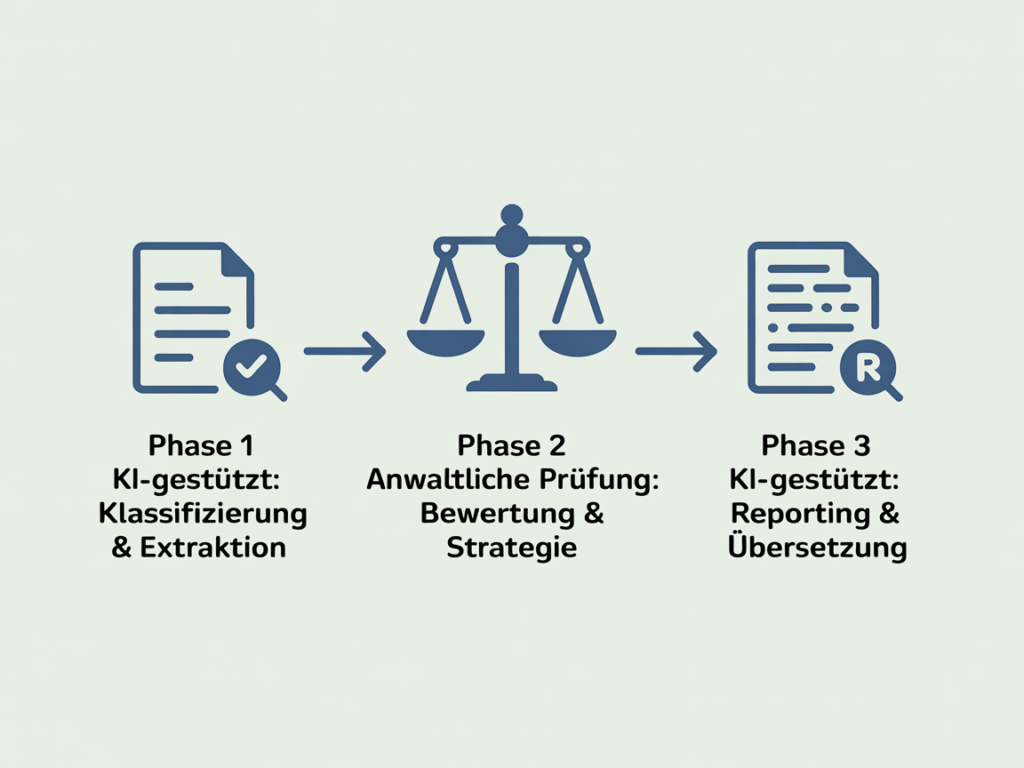
A complete automation of due diligence is neither realistic nor permitted under professional law. But an intelligent division of labor between humans and machines can increase your efficiency:
Phase 1 (AI-supported): Document classification, initial risk identification, summaries, data extraction
Phase 2 (Legal review): Assessment of the identified risks, legal classification, strategic advice
Phase 3 (AI-supported): Report creation, translation, formatting
Depending on the document mix and maturity of the implementation, teams report significant savings in pure document review. Providers of review tools speak of 40 to 60 percent time savings in routine reviews. These values are based on experience and vary depending on the application. Time that your lawyers can use for the actual legal work.
Why auraHub for law firms?
No prompt knowledge required: Structured input masks instead of free text input.
Multi-LLM support: Claude, GPT-4, Gemini, Mistral. One interface, multiple models. You choose the right model for the task at hand.
Your branding: auraHub can be fully adapted to your law firm’s CI.
Scalable: From sole proprietorships to large partnerships, on-premises or cloud.
Structured introduction: Depending on the complexity of your requirements, we start with a proof of concept to validate the benefits for your specific use cases.
AI as a tool for the modern law firm
The question is no longer whether AI is used in due diligence, but how. Law firms that shape the entry now gain a competitive advantage. In terms of efficiency, fees and employee satisfaction.
auraHub makes this entry practical: GDPR-compliant, compliant with professional law, without your lawyers having to become prompt engineers. The legal control and responsibility remains where it belongs: with the human.
Frequently asked questions about AI in due diligence
Can AI replace legal due diligence? No. AI supports document analysis, classification and risk detection. The legal assessment, classification and responsibility remains with the lawyer. The BRAK guidelines make it clear: AI may support, not replace.
Is the use of AI in law firms GDPR-compliant? That depends on the configuration. auraHub can be operated on-premises, so that client data does not leave its own infrastructure. When using the cloud, it must be checked which data is transmitted to which provider.
What does the BRAK say about the use of AI in law firms? The German Federal Bar Association published a guideline in January 2025. Key points: independent review of all AI results, adherence to the duty of confidentiality, transparency towards clients.
What time savings are realistic? Depending on the document mix, teams report time savings of 40 to 60 percent for routine reviews. These values are based on practical experience, not a guarantee. The greatest effect occurs during initial classification and data extraction.
Do lawyers need prompt knowledge for auraHub? No. auraHub works with structured input masks instead of free text input. Employees fill out forms and receive structured results. No prompt engineering required.
What does the EU AI Act mean for law firms? Since February 2025, the obligation to have AI competence has applied in accordance with Art. 4 AI-VO. Law firms must ensure that employees are adequately trained. Enforcement begins in August 2026.
Would you like to see how auraHub can support your due diligence processes?
In 30 minutes, we’ll look at your processes together and identify where an AI agent would really save time and where not.
Post Tags :
Share :
AI Due Diligence, Law Firms AI, Document Analysis AI, Contract Analysis AI, M&A Due Diligence, AI Risk Detection, BRAK AI Guidelines, GDPR Lawyers, auraHub Law Firms, AI Document Classification, Automation Law Firms, Legal Tech AI, AI Compliance Lawyers
More articles on this topic
AI in the skilled crafts. Practical examples of AI use in skilled crafts businesses and how to get started.
Individual instructions for AI. How to optimally use ChatGPT and Claude to achieve better results.
AI visualization for craft businesses. AI tools for visualizing projects – a practical application for craftsmen.
AI Governance thought pragmatically. How to introduce AI guidelines without stifling innovation.