
From on-site appointment to contract confirmation in 48 hours.
While others are still printing the quote, the competition has already signed. Why speed and visual impact are the new competitive factors in the trades in 2026.
Three quotes. One family. One clear winner.
A family from Sauerland is planning a roof renovation. The house is 35 years old, the tiles are cracked, and heating costs have been rising for three years. They request three quotes.
Company A visits once, measures for an hour, promises a quote within the next two weeks. It arrives after twelve days as a PDF with a gross total and three lines of description.
Company B is similar. On-site appointment, silence, then a standard quote by mail. Eight days later.
Company C is different. The owner arrives with an iPad. While measuring the roof, he shows the family three visualizations of their own house on the screen: one with classic red clay tiles, one with anthracite concrete roof tiles, one with slate. Upon request, supplemented with a solar system. Plus a note on which funding programs are currently available.
Two days later, the quote is ready, detailed, with all three options and a clear funding recommendation. Three days later, the family signs.
Which company received the contract is obvious. The more interesting question is why.

to quote
in roofing companies
to first impact
In the trades, speed is now a sales factor.
The on-site appointment in roofing sales is one of the most intensive sales situations in the trades. The customer is emotionally engaged, the project is large, the decision often takes months. Nevertheless, most appointments have followed the same pattern for years: go there, measure, make recommendations, calculate in the office, send quote.
The problem with this pattern: it leaves the customer's attention window unused. Those renovating a roof are maximally interested during the appointment. A week later, the willingness to decide has noticeably decreased. Three weeks later, the customer compares five quotes, none of which feel right anymore, and makes the decision based on price.
Those who can show a concrete image at precisely this moment win disproportionately. Not because the image is perfect, but because the customer sees what they otherwise only guess. From "approximately anthracite" to "this one, exactly like this". You know this logic from landscaping, which we described in detail in our article What You Can See Gets Sold. In roofing companies, the same principle works, just with different materials.
The German Confederation of Skilled Crafts has been documenting increasing competitive pressure and declining margins in the construction trades for years. The companies that hold their ground against this trend take a common step: they maximize the hour during the appointment instead of treating it as mere data collection.
Four AI levers that work in a roofing company.
You do not need twelve tools simultaneously. Four levers are decisive in practice, and each directly contributes to contract acquisition or margin growth.
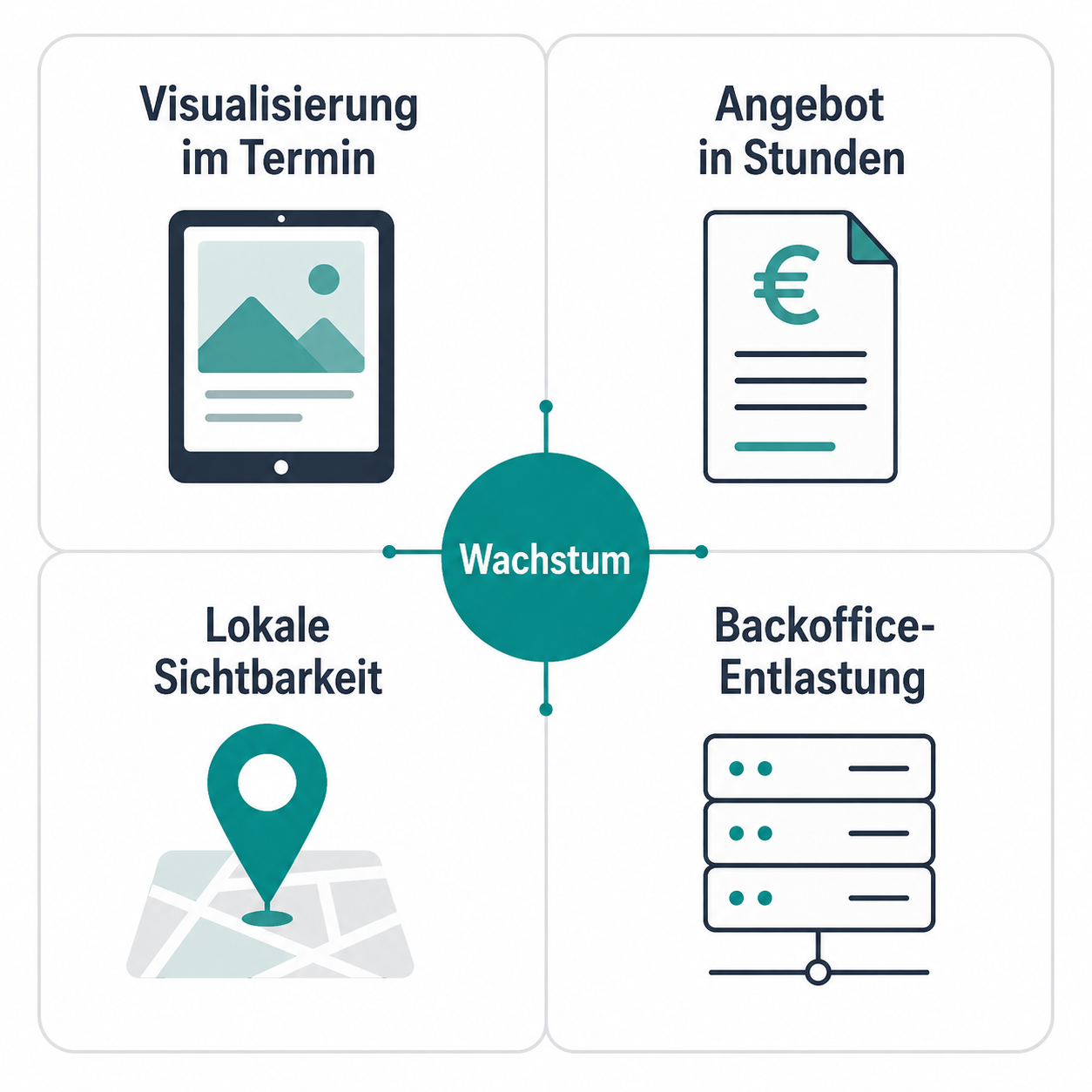
More contracts without more employees.
What happens when you combine these four levers is not primarily efficiency. It is growth.
The acceptance rate increases because the sales conversation becomes more concrete and faster. Contract processing accelerates because there is less friction in the back office. Visibility attracts additional inquiries because potential customers find you earlier. And your employees stay longer in the company because they have to do less routine work.
The result: you write more contracts with the same team. With scarce skilled workers, this is the decisive growth lever, because the usual answer "then we hire someone else" simply does not work. The ZDH has quantified open positions in the construction trades at a high level for years; short-term relief through the labor market is realistically not to be expected.
Data Protection and Data Clarity as Prerequisites
An important prerequisite for long-term use is clarity about where customer and contract data are processed. Those who process data from storm damage, grant applications, or insurance processing in public models risk data protection violations. How to solve this question architecturally in a clean manner is described in The Platform Is Not the Problem.
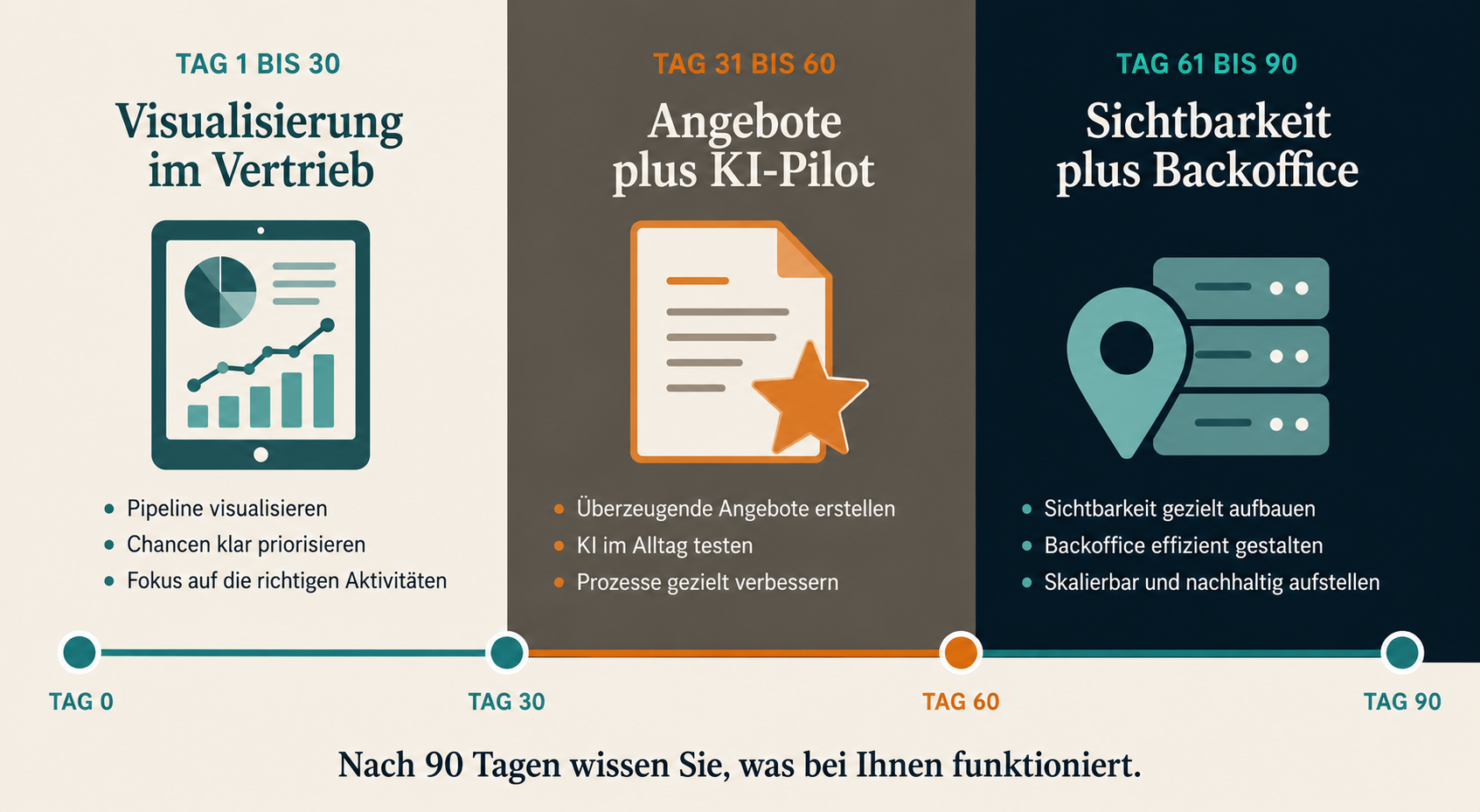
Start small, in 90 days on a solid foundation.
The typical concern in the trades: this will be too much at once. It is justified, but it resolves when you start small.
-
01 · Day 1-30
Visualization in Sales
You test a single lever in sales, preferably visualization. You measure whether the acceptance rate during appointments changes noticeably. You train two or three salespeople and let them work with it. Goal: first empirical values from your own company.
-
02 · Day 31-60
Quotes Plus AI Pilot
You add quote preparation and transfer one or two templates into the AI system. In parallel, you define a responsible person in the company who coordinates the AI implementation. A clear role, not necessarily a new position. Goal: measurably shorten throughput time.
-
03 · Day 61-90
Visibility Plus Back Office
You expand to include local visibility and back-office routine. You see the impact in the pipeline and in back-office hours. Goal: scalable and sustainable setup that grows with your contract volume.
After 90 days, you have not exhausted all possibilities, but you know what works for you and where the next lever is.
30 minutes. Your company. An honest assessment.
In the initial consultation, we discuss your specific situation and which lever would have the fastest effect for you. Free of charge, without sales presentation, with honest assessment of whether AI is a sensible step for your company in the next six months or whether you should wait.
Schedule an appointment →Frequently asked questions
What does AI specifically bring to a roofing company?
Four concrete levers. Visualization during appointments: the customer sees the finished roof in under one minute on the tablet. Quote preparation in hours instead of days with industry templates and funding information. Local visibility in Google and ChatGPT. Back-office relief for grant applications, insurance processing, and documentation. Together, this leads to more contracts without additional employees.
How long does it take until the first impact becomes visible?
In the 30-day pilot with visualization during appointments, you see noticeable effects in the first sales conversations. A reliable impact on acceptance rate and contract value typically becomes apparent after 60 to 90 days, once three of the four levers are running in daily operations.
Does this also work for smaller roofing companies?
Yes. The levers scale downward because they address specific sales and back-office processes, not company size. Even companies with five to fifteen employees benefit greatly, because there the owner is directly involved in sales and every hour is directly revenue-generating.
What distinguishes auraHub from ChatGPT?
auraHub runs as a self-hosted AI platform in your infrastructure. Customer data, quotes, and internal documents remain physically with you. ChatGPT is a public cloud application with data protection restrictions for sensitive business data. Details under The Platform Is Not the Problem.
Do I need an IT specialist in the company?
No. The platforms are designed as ready-to-use applications that your employees can operate without IT background. What you need is a responsible person in the company who coordinates the implementation. This can be the owner, the office specialist, or a technically interested salesperson.
What does implementation cost in the first year?
The specific costs depend on the chosen setup and are transparently calculated in the initial consultation. Rule of thumb: the monthly costs for the platforms are typically in the low four-figure range, plus one-time setup and training expenses. For mid-sized companies, this typically pays for itself through additional contracts in the first half-year.