
AI Garden Planning: Why the Warning Is Justified, but Targets the Wrong AI
ChatGPT is a single language model without industry context. auraVision and auraQuote are orchestrated multi-AI systems that link weather APIs, plant databases, pollen APIs, and location data in real time. Why the difference is crucial for landscaping businesses.
On Instagram, a well-known landscaping account warns against AI garden planning with ChatGPT. The gist: the AI knows neither the clay soil nor the slope, provides a plant list but no reliable drainage concept. Save yourself the tuition fees. Plan with the professionals.
This warning is correct. Completely.
And it has personally occupied me as a certified AI Manager, long before auraNexus.ai existed. Since 2023, I have been working on the question of how AI can be used sensibly in garden visualization and landscaping cost estimation: not as a replacement for expertise, but as an amplifier of it. auraNexus.ai has been the answer since December 2025. With auraVision for photorealistic garden visualization and auraQuote for location-based quote creation. Both products do not work with a single AI, but with several specialized models that work in parallel and are orchestrated together, integrating real-time APIs for weather, plants, pollen, and location data.
This article explains why the justified criticism of ChatGPT does not apply to context-based multi-AI systems, which data sources and APIs are behind them, and what landscaping businesses specifically gain from them.
One Model vs. Many: The Structural Difference
ChatGPT is a single large language model. It is trained to provide a plausible answer to as many questions as possible—generic, context-free, universal. That makes it an impressive generalist, but a poor specialist.
Behind auraVision and auraQuote is a fundamentally different architecture: multiple specialized AI models that work in parallel and are orchestrated together in a pipeline, accessing external data sources in real time. No model has to do everything. Each model does exactly what it was optimized for.
That is the real difference from ChatGPT. Not industry context alone, but the architectural decision: specialized instead of universal, orchestrated instead of monolithic, with real data instead of frozen training knowledge.
Real-Time Data as the Foundation: What Powers Location Intelligence
What sets auraVision and auraQuote apart from any general-purpose language model is not only the architecture, but also the data foundation. Instead of relying on static training knowledge, the systems draw on specialized real-time data sources that provide information relevant to the landscaping context.
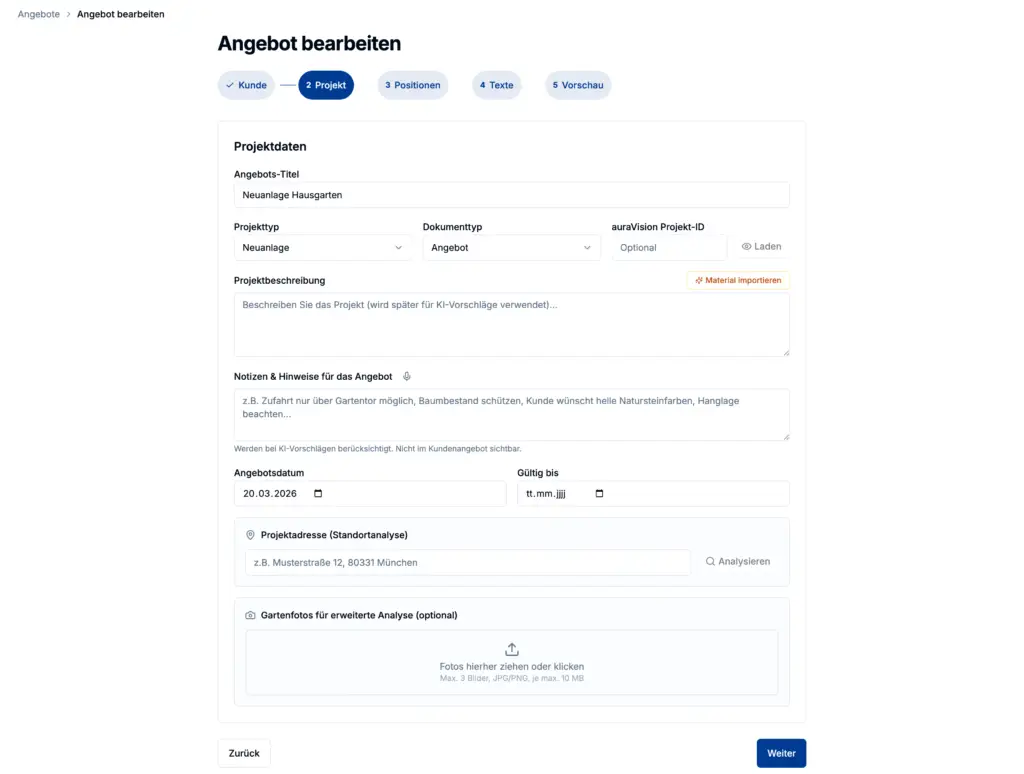
When a company enters a project address in auraQuote, high-resolution climate data from national weather services is automatically retrieved in the background: sunshine hours, local frost risk, precipitation. These values flow directly into plant selection and into the individualized site text that is automatically written into the quote.
This is complemented by location-accurate pollen data. For landscapers, this provides a tangible consulting argument: during plant selection, the system can automatically flag which species increase the pollen load at the specific location and which are particularly suitable for allergy sufferers—data no competitor can provide without comparable system integration.
For plant selection itself, auraQuote draws on structured botanical databases: maintenance effort, water requirements, light requirements, growth height, flowering period, and climate suitability for thousands of plant species. Plants that do not match the USDA climate zone or the site’s light conditions are automatically highlighted in color in the wizard. The landscaper makes the decision, but with complete, verified information.
The data sources currently integrated for weather, pollen, and plant data are just the beginning. Additional location-relevant information is in development. The goal: over time, auraQuote should know each site so precisely that, in the very first quoting meeting, a landscaper can already argue with real, verified location data—without having to research it manually.
Why ChatGPT Is the Wrong Tool for Garden Planning
No single language model has access to this real-time data. It does not know the current pollen season in Frechen, a frost date in Cologne-Porz, or a current plant catalog with location-filtered selection. It answers with training knowledge that is frozen after a cutoff date and has no connection to a specific address.
This is not a flaw in the technology. It is a flaw in the application. Professional landscaping planning lives on context: location, climate, exposure, soil conditions, existing planting, and the judgment of an experienced specialist company. No language model replaces that expertise. The question is therefore: Which AI knows the context—and draws real data from real sources?
The Problem with Traditional Garden Planning: Time
German garden and landscaping is a heavyweight industry. According to the BGL industry statistics 2025, industry revenue grew to €11.11 billion in 2025—the 16th consecutive year of growth. Nearly 19,900 companies employ more than 131,000 people. Private gardens remain the strongest segment at around 57%.
And yet: every landscaper knows the problem. It often takes days, sometimes weeks, before a first draft reaches the customer. For a mid-sized quote with paving work, planting, and fence construction, experienced companies report from practice that documentation alone quickly ties up two to three hours—regardless of the actual cost calculation. This is exactly the double bottleneck the auraNexus workflow resolves.
Step 1: auraVision Delights
auraVision is the first stage. Five specialized AI models work together in an orchestrated pipeline to generate a photorealistic garden view from a smartphone photo in 60 seconds—using real products from well-known manufacturers.
- Image analysis models identify the house, hedge, patio, and existing elements.
- Translation models convert customer wishes into precise image instructions using a proprietary three-zone system.
- Generation models create the final image with realistic material surfaces and lighting.
- Quality assurance models evaluate and optimize the result before delivery.
The three-zone system ensures that the customer recognizes their own house. Only then does the emotional connection arise that triggers purchase decisions. auraVision automatically generates day and night views and suggests professional planting with depth layering, fed by verified botanical databases.
More on this in the article From Customer Photo to Dream Garden Visualization in 60 Seconds.
Step 2: auraQuote Puts a Price on It
After the excitement comes the inevitable question: What does it cost? auraQuote answers it with an orchestrated system of specialized models and real-time data sources:
- Site analysis: Geocoding and USDA climate zone are combined with high-resolution climate data from national weather services. Sunshine hours, frost risk, and precipitation for the specific project address—automatically and without manual research.
- Pollen data: Location-accurate information on which plants increase the pollen load in which season and which are suitable for allergy sufferers.
- Plant data: Structured botanical databases provide flowering period, growth height, light requirements, and maintenance effort. Unsuitable plants are highlighted in color.
- Costing engine: A proprietary industry database with 19 trades and over 85 catalog items calculates using market-standard time values and material prices.
- Text generation model: Generates professional line-item texts and the individualized site text directly into the quote.
- Completeness check: A separate analysis model checks four categories: missing trades, missing line items, optimization suggestions, and price plausibility.
The result is not hallucinated text, but a calculated and verified quote based on real location data. Exportable as PDF, Word, or GAEB (.x84) for direct import into industry software.
The completeness check can be tested for free and without login. The article AI-Assisted Quote Creation in Landscaping explains the full technical background.
How auraVision and auraQuote Structurally Differ from ChatGPT
The comparison makes the difference clear:
ChatGPT | auraVision / auraQuote | |
AI Architecture | A single language model | Multiple specialized models in an orchestrated pipeline |
Data foundation | Frozen training knowledge | Real-time data from specialized expert sources |
Project address | Unknown | Data point for automatic site analysis |
Climate zone | None | USDA zone determined automatically |
Location data | None | Weather, pollen, plants—continuously expanded |
Plant selection | General | Filtered by frost risk, sunshine hours, and site suitability |
Bill of quantities | Free text | 19 trades, 85+ line items with costing rules |
Completeness check | None | Traffic-light system with specific guidance |
Export | Copy from the browser | PDF, Word, GAEB (.x84) |
Step 3: GaLaOffice 360° Handles Execution
auraQuote is not an ERP system. It is the specialized assistant for the quoting bottleneck. That is why the cooperation with craftview / KS21 is so consistent. GaLaOffice 360° covers the process from the won contract onward: preliminary costing with company-specific overhead rates, order processing, post-calculation, invoicing. What was missing was the moment before that.
The planned API integration creates an end-to-end digital workflow without media breaks:
- auraVision delights: Multi-AI pipeline generates photorealistic visualization on site at the customer’s location.
- auraQuote puts a price on it: Orchestrated AI systems with real-time data create the quote directly from the visualization.
- GaLaOffice 360° handles execution: Company-specific overhead rates, order processing, post-calculation, invoicing.
AI in Landscaping: Specialization and Real Data Beat General Knowledge
The core idea can be condensed into two sentences: A single universal AI with frozen training knowledge cannot plan a garden. Multiple specialized AI models that know the context, integrate real-time data from weather, pollen, and plant databases, and work together in an orchestrated way can help landscaping businesses work better and faster.
This aligns with an observation from my AI consulting work: AI does not fail because it is too weak. AI fails because it is used incorrectly. One model for everything is almost always the wrong tool. This applies to AI in the trades in general just as much as it does to landscaping.
auraNexus.ai is still young—four months old. But the questions the product answers have been occupying the industry for years. The difference is that we now have answers that are based on real data and work in everyday landscaping operations.
Frequently asked questions
Can AI replace the garden planning of a professional landscaping company?
No. Neither a single language model nor a multi-AI system can replace soil conditions, local terrain knowledge, and construction experience. auraVision and auraQuote support the professional with real location data, but they do not replace them.
Which data does auraQuote use for site analysis?
auraQuote combines multiple real-time data sources: high-resolution climate data from national weather services for sunshine hours, frost risk, and precipitation; location-accurate pollen data for allergological plant assessment; and structured botanical databases with maintenance effort, growth height, light requirements, and climate suitability for thousands of plant species. The ecosystem is continuously expanded.
What do pollen data specifically provide for landscaping businesses?
In the quoting meeting, auraQuote can automatically flag which plants increase the pollen load at the specific location and which are particularly suitable for allergy sufferers. This is a consulting argument that no competitor can provide in this way without system-side location data.
What differentiates auraQuote from ChatGPT for landscaping businesses?
The structural difference: ChatGPT is a single language model with frozen training knowledge and no location reference. auraQuote combines multiple specialized systems with real-time location data, an industry-specific costing engine with 19 trades and 85+ line items, as well as AI text generation and a completeness check. The result is a quote based on real data—not hallucinated text.
Since when has auraNexus.ai existed?
auraNexus.ai was founded in December 2025. Founder Oliver Range has been working on the use of AI in garden visualization and landscaping cost estimation since 2023, with more than two years of preparatory work and over 20 years of experience in digital transformation.
Can I test the completeness check for free?
Yes. The AI completeness check is available free of charge and without login. Simply upload an existing quote and the system checks it for missing trades, line items, and price plausibility.
Test auraQuote now
auraQuote is in beta and is currently being further developed with selected landscaping businesses. The AI completeness check is available immediately free of charge. If you use GaLaOffice 360°, you can contact us directly about the planned integration.
Post Tags :
Share :
AI agents for medium-sized businesses, AI in crafts, AI agents for crafts, AI automation for companies, automation for craft businesses, workflow automation for crafts, AI agent costs, Make.com automation, n8n workflow, automation ROI, AI agent practical examples, digital automation for crafts, artificial intelligence automation
More articles on this topic
Garden Visualization with AI – auraVision for Landscapers. AI-powered garden visualization in 60 seconds with day/night variants and real products.
AI-Assisted Quote Creation in Landscaping. auraQuote creates professional quotes with AI. 13 trades, 85+ catalog items, GAEB export.
AI in the skilled crafts. Practical examples of AI use in skilled crafts businesses and how to get started.
Custom GPTs in the enterprise. Limitations of Custom GPTs and why alternatives are needed for enterprise.