From Rearview Mirror to Radar:
Why communication teams need a forward-looking perspective
Media monitoring shows what was written yesterday. Media Intelligence shows what is coming tomorrow. The difference is crucial for any communications department that wants to work proactively rather than reactively.
When I ask communications managers what they primarily use their media monitoring for, I usually get the same answer: to see what has been written about the company, to observe competitors, and to inform the board. This is legitimate. And it is the rearview mirror.
What I have learned in 20 years of digital media monitoring: the rearview mirror is necessary, but it is not sufficient. The real strategic question is not “What was written?” but “What comes next?”
The Media Intelligence module in auraPress answers exactly this question. It combines daily press evaluation with trend analysis and an AI-supported outlook into a system that does not just document, but anticipates.
Monitoring and Intelligence: Where the Difference Lies
A classic press review is an archive. Well-executed, complete, and structured, it provides an overview of what has been. It is the foundation. But it only answers the simplest of all questions: what was written where and when.
Media Intelligence goes a conceptual step further. It uses the press review as raw material and operates on three levels simultaneously.
The first level is pattern analysis: Which topics are appearing more frequently than four weeks ago? Where are tonalities shifting? Which narratives are currently emerging in reporting before they become dominant headlines?
The second level is contextualization: What do these patterns mean for your own communication situation? Which journalists are writing more frequently about specific topics? Which sources are setting the agenda, and which are following suit?
The third level is anticipation: If a topic has developed in this way, what questions will journalists ask in three weeks? Which arguments should the communications department prepare for today?
These three levels cannot be mapped with a classic monitoring tool. They require a different architecture. That is exactly what Media Intelligence in auraPress provides.
The Three Building Blocks of Media Intelligence in auraPress
The Media Intelligence module in auraPress consists of three building blocks that build upon one another. Each block has its own purpose. Together, they form a complete picture of the media landscape that connects the past, present, and future.
Building Block 1: The Press Review as a Structured Foundation
The press review is the first building block and the daily basis for work. auraPress processes press reports from all relevant sources and presents them in a structured manner: articles sorted by date, source, tonality, and topic area, with full text and a direct link to the original source. This sounds like classic monitoring, and it is—with one crucial difference: the press review in auraPress is not a static archive, but the database for all further analyses. Every article contributes to the pattern recognition of the Trend Radar. Every source flows into the source weighting of the AI Outlook. For communications teams, this means: the morning press review is not just a daily overview, but raw material for strategic decisions.Building Block 2: The Trend Radar as an Early Warning System
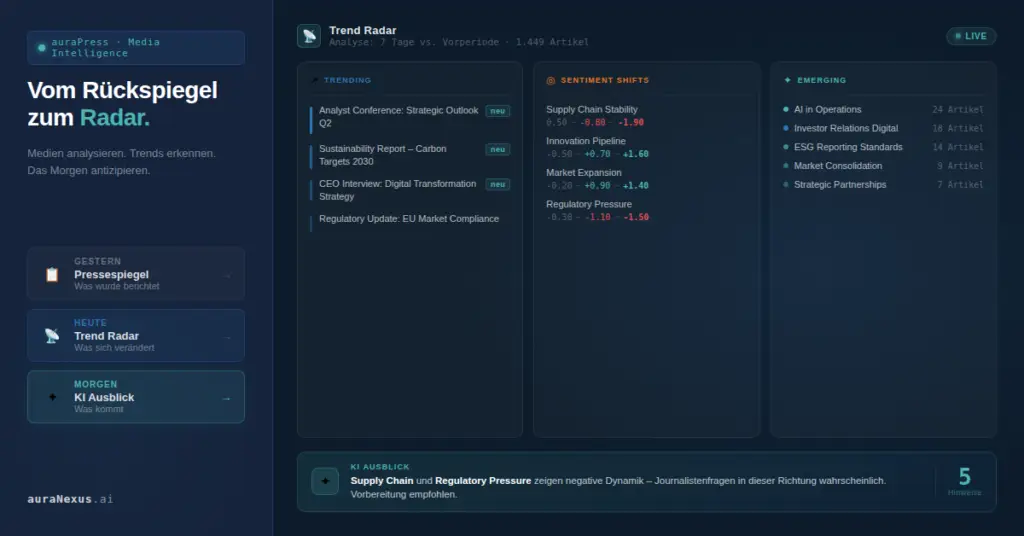
The Trend Radar is the analytical core of Media Intelligence. It analyzes press coverage over time and identifies three categories of movements relevant to strategic communications.
Trending topics are content items that have appeared significantly more frequently in recent days than in the previous period. The system marks them as new if they appear for the first time within a defined window or become relevant again after a long break. These topics do not require an immediate reaction, but they do require attention.
Sentiment Shifts show where the tonality in reporting has changed. A topic that was rated neutral for months and suddenly takes on critical undertones is an early signal of potential reputational risks. A topic whose sentiment shifts from critical to neutral or positive signals a calming news situation. The Trend Radar shows these shifts with concrete numerical values across three points in time, making the dynamics recognizable at a glance.
Emerging Topics are subjects that still have little coverage but are measurably gaining momentum. These are the signals that classic monitoring systematically overlooks because they are simply too small to be noticed in the daily overview. In the Trend Radar, they are displayed with the number of articles and the direction of development. For experienced communications professionals, these are often the most valuable insights.
Building Block 3: The AI Outlook as a Sparring Partner
The AI Outlook is the true innovation in Media Intelligence and the building block that most distinguishes auraPress from classic monitoring solutions.
It analyzes patterns from the press review and Trend Radar and generates a structured outlook: Which topics are likely to gain relevance in the coming days or weeks? Which questions should the communications department prepare for? Where is there a need for action?
In this process, the AI Outlook does not act as an automaton producing finished answers, but as a thinking partner formulating hypotheses that the communications team can evaluate and prioritize. The insights are linked to the underlying articles and sentiment values, ensuring every assessment remains transparent and verifiable.
In practice, this means: the communications team opens the AI Outlook in the morning and sees five structured insights. Insight one states that the topic of supply chain stability has become strongly negative in the reporting of the last three days and journalists are likely to ask questions in this direction. Insight two shows that an emerging topic regarding a regulatory change is currently gaining momentum. Insight three provides a positive note: the topic of the innovation pipeline is gaining positive sentiment and offers a communication opportunity.
This is not a replacement for the judgment of the communications professional. It is the raw material that sharpens that judgment.
What the Trend Radar shows:
|
How Media Intelligence Changes Practice
The difference between Monitoring and Intelligence is most evident in concrete work situations. Three practical examples illustrate what changes for communications teams.

Preparation for Press Conferences and Analyst Calls
Preparing for an annual press conference or a capital markets day was long a weeks-long manual process. Teams read hundreds of articles, distilled topics, anticipated journalist questions, and developed answers. The result was 15 to 20 prepared questions, often with significant blind spots regarding critical side issues.
With auraPress, the Media Intelligence module provides a complete briefing report from the same source data: structured topic analysis, sentiment development by topic area, source weighting, and an AI Outlook with the most likely journalist questions. For a listed company, this has meant in practice: 71 prepared questions with draft answers, bilingual in German and English, with embedded real-time data from the capital market, within a few days instead of several weeks.
This is not a replacement for communications professionals. It is a different starting point for their work.
Reputation Monitoring with Early Warning Function
Classic monitoring reacts to reputation crises once they have already emerged. The morning press review shows what went wrong yesterday. This is important, but it is always crisis reaction, never crisis prevention.
The Trend Radar in auraPress identifies sentiment shifts before they solidify into a dominant narrative. A single critical article is not a signal. Three critical articles from three different sources within five days on the same topic is a signal. The system recognizes these patterns automatically and provides a structured alert before the topic reaches the front page.
For communications departments, this means: more time for a considered reaction instead of hectic crisis management.
Continuous Agenda Tracking
Communications teams responsible for multiple markets or topic areas quickly lose track of which topics are currently truly relevant and which are just loud. The Emerging Topics function in the Trend Radar solves this problem structurally.
The system shows weekly which new topics are appearing in reporting and building momentum before they appear on the general radar. This is particularly valuable for industry-specific topics that are systematically overlooked in generalist monitoring solutions.
Media Intelligence in the Context of the auraPress Platform
Media Intelligence is one of several modules in auraPress that together form a complete media intelligence platform for capital market communications. Understanding how the modules interact makes the added value of Media Intelligence even clearer.
The press review provides the daily foundation of processed press articles. Media Intelligence strategically evaluates this foundation with Trend Radar and AI Outlook. The Question and Answer database, another core module of auraPress, uses the same database to store anticipated journalist questions with complete draft answers—bilingual and with embedded financial KPIs from the capital market.
The Analyst Report, also part of the platform, integrates financial analyst opinions and external market data, so the communications department knows not only the media perspective but also the capital market perspective on relevant topics.
The result is a platform that brings together all relevant information streams for strategic corporate communications in one place: media, analysts, financial KPIs, and AI-supported anticipation.
Who is Media Intelligence in auraPress relevant for?
The Media Intelligence module is aimed at three target groups in corporate communications.
Capital market communications in listed companies is the original and most validated application. Investor Relations teams, press spokespersons, and communications managers who regularly prepare press conferences, analyst calls, and quarterly briefings benefit directly from the combination of structured trend analysis and AI Outlook.
Communications agencies managing multiple mandates simultaneously use Media Intelligence as a structured analysis process that is consistent and reproducible for every mandate. Instead of manual research before every briefing, the system provides a structured starting point that sharpens the content of the consulting conversation.
Corporate communications in press-relevant sectors such as pharma, energy, financial services, and industrial companies that are regularly confronted with critical reporting use reputation monitoring with an early warning function to react more proactively to emerging narratives.

What technology is behind Media Intelligence in auraPress?
auraPress is a fully cloud-based platform built on a modern stack architecture with Next.js, PostgreSQL, and a proprietary analysis engine. The platform sources media data via the professional media monitoring infrastructure of newslive GmbH, which, as a partner company of auraNexus.ai, enables direct vertical integration without third-party risk.
For language processing and the AI Outlook, auraPress uses several leading language models that are combined depending on the task. The decision to combine multiple models instead of being dependent on a single provider is a deliberate architectural choice that ensures quality and resilience.
The Trend Radar is based on a proprietary analysis engine that compares article volume, sentiment values, and source weighting over defined time windows. The time windows are fully configurable, allowing for both short-term movements (3 days vs. 30 days) and long-term trend analyses.
The platform is GDPR-compliant and operated on European infrastructure. Two-factor authentication, role-based access control for Viewer, Editor, and Admin, and daily backups secure the data. Customer data and analysis data are not used for training AI models.
Frequently Asked Questions about Media Intelligence in auraPress
What is the difference between media monitoring and Media Intelligence?
Media monitoring documents what has appeared in the press: who wrote what about a company, when, and where. Media Intelligence goes beyond this and strategically evaluates this data: what patterns are emerging, where tonalities are shifting, and which topics will be relevant tomorrow. Media monitoring provides data. Media Intelligence provides a basis for action.
What is the Trend Radar in auraPress?
The Trend Radar is the analytical heart of the Media Intelligence module. It analyzes press coverage over time periods and identifies three categories: Trending topics (increased volume), Sentiment Shifts (tonality changes with concrete numerical values), and Emerging Topics (new topics with measurable momentum). The time window is configurable, defaulting to 3 days vs. a 30-day previous period.
What is the AI Outlook and how does it work?
The AI Outlook is an AI-supported analysis block within Media Intelligence. It evaluates patterns from the press review and Trend Radar and generates structured insights: which topics the communications department should prepare for, which journalist questions are likely, and where communication opportunities or reputation risks are arising. Every insight is linked to the underlying data points and is transparent.
How does auraPress differ from classic monitoring solutions?
Classic monitoring solutions are optimized for completeness and reach: as many sources as possible, the fastest possible notification, and the best possible dashboards for documentation. auraPress is optimized for strategic foundations for action: structured trend analysis, AI-supported outlook, and direct integration with capital market data and Q databases. The target group is not social media managers, but communications managers at the decision-making level.
Which companies is auraPress suitable for?
auraPress was originally developed for the capital market communications of listed companies and is most validated there. However, the platform is transferable to any type of strategic corporate communication: product launches, crisis communications, reputation monitoring, political communications. The connecting element is always the desire not just to know what was, but to be prepared for what is coming.
Which data sources does auraPress use for media monitoring?
auraPress sources media data via newslive GmbH, a professional media monitoring company with its own source network for the German-speaking and international markets. This direct integration eliminates third-party risks and ensures data quality. Additionally, external data sources such as Talkwalker can be connected via XLS integration, allowing existing monitoring contracts to be used as a complementary data basis.
How is auraPress deployed and how long does implementation take?
auraPress is a fully cloud-based platform that can be used without technical installation. The setup of a new tenant, including topic configuration, source selection, and user creation, is performed by the auraNexus.ai team. For new mandates, the platform is usually ready for use within a few days.
Can auraPress also be used for multiple mandates or multiple languages?
Yes. auraPress supports multiple mandates with completely separate databases and role-based access control. The platform is designed for bilingual operation, standardly German and English. Press reviews, AI Outlook, and the Q database can be maintained in both languages in parallel.
Get to know auraPress
Interested communications managers can book an appointment for a personal demonstration directly.
Post Tags :
Share :
Media Intelligence, Trend Radar, KI Ausblick, Medienmonitoring, Pressekonferenz Vorbereitung, Journalistenfragen, auraPress, Sentiment Shifts, Emerging Topics, Kommunikationsstrategie, Krisenkommunikation, Reputationsmanagement, Antizipation KommunikationMore articles on this topic
Press Conference Preparation with AI – auraPress for IR Teams. AI-powered press conference preparation with a 92% hit rate for journalist questions.
AI Financial Analysis for Annual Press Conferences. AI combines media analysis with automated financial analysis for annual press conferences, earnings calls, and investor relations.
AI Governance thought pragmatically. How to introduce AI guidelines without stifling innovation.
Custom GPTs in the enterprise. Limitations of Custom GPTs and why alternatives are needed for enterprise.